
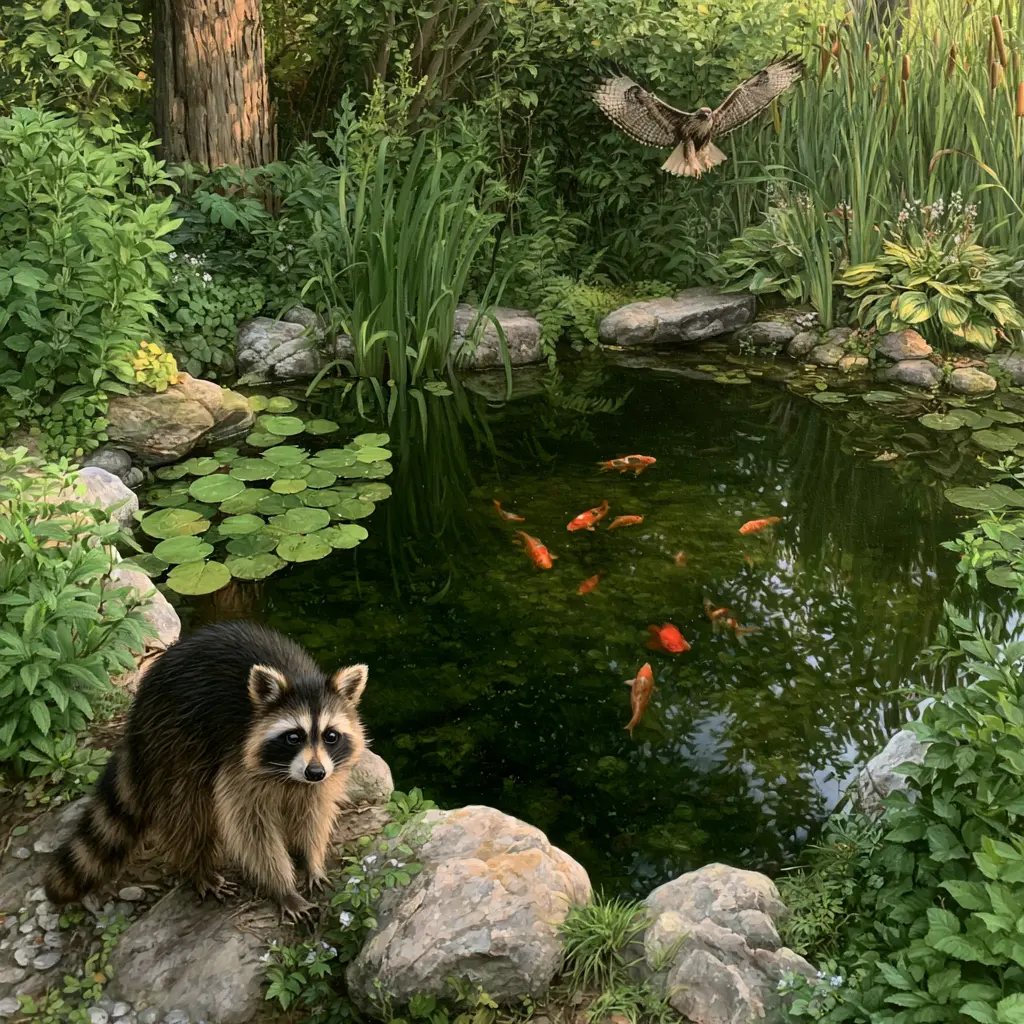
There is a particular kind of quiet that settles over a koi pond on an October morning. The water has cooled, the fish are moving a little slower, and the maples around the yard are beginning to drop their first leaves onto the surface. It is one of my favorite times of year to sit by the water with a cup of coffee. It is also, as I learned the hard way years ago, one of the most dangerous times of year for the fish.
The first time I lost koi to a predator, there was no drama to see. I came out one morning and counted the fish, then counted them again. Two of my best were simply gone. No bodies, no torn netting, no obvious clue. A few days later, just after sunrise, I saw the culprit: a great blue heron standing perfectly still at the shallow edge of the pond, as calm as a lawn ornament. It looked at me, took its time, and lifted off with a few slow wingbeats. It had clearly been there before, and it clearly planned to come back.
That moment changed how I think about pond design and seasonal care. Protecting koi is not just about water quality and good food. It is about understanding that a beautiful, clear pond full of brightly colored fish looks like a buffet to a surprising number of animals.
This month, I want to walk through the predators that visit ponds here in the Northeast, why autumn raises the stakes, and the practical, humane steps that have kept my fish safe since.
Why Fall Is Predator Season
Several things line up in autumn that make koi more vulnerable than they are in midsummer.
First, the water clears. As temperatures drop, algae growth slows, and a pond that was a little green in August can become crystal clear by October. That is lovely for us, but it also means a bird overhead can see every fish in the pond.
Second, the fish slow down. Koi are cold-blooded, and as the water cools their metabolism drops. A koi that would dart away from a shadow in July may react a half-second later in October. For a heron, that half-second is everything.
Third, many wild animals are on the move or fattening up. Some herons shift territory as the season turns, young birds born that spring are learning to hunt on their own, and mammals like raccoons are eating heavily ahead of winter. A reliable food source in a backyard is exactly what they are looking for.
Finally, plants die back. The lilies and marginal plants that gave fish cover all summer begin to fade, leaving fewer places to hide. If you have read my 8 top tips for winterizing your koi pond, you know I recommend trimming dying foliage to protect water quality. The trade-off is that you need to replace that natural cover with something else.
Meet the Usual Suspects
The Great Blue Heron
If you keep koi anywhere in North America, the great blue heron is the predator you are most likely to meet. According to the Cornell Lab of Ornithology’s great blue heron profile, these birds hunt patiently along shorelines and pond edges, often standing motionless before striking “like lightning” to grab a fish. They weigh only about five to six pounds thanks to hollow bones, yet they can hunt both day and night.
That last point surprised me. I had always assumed a heron was a daytime problem. In practice, most of my visits came at dawn and dusk, which matches what wildlife specialists describe: herons are primarily daytime sight feeders, but they will feed at night when there is good moonlight.
Herons are also creatures of habit. Once a bird finds an easy meal, it will return, sometimes daily, until the pond stops paying off. The goal is to make your pond a bad investment as quickly as possible.
One important note before we go any further: great blue herons, like other herons and egrets, are protected under the federal Migratory Bird Treaty Act. The USDA APHIS Wildlife Services technical guide on herons and egrets makes clear that harming these birds requires a depredation permit from the U.S. Fish and Wildlife Service. For a backyard koi keeper, the answer is always exclusion and deterrence, never harming the bird.
Raccoons
Raccoons are the night shift. They are mostly nocturnal, remarkably clever, and have extraordinary dexterity in their front paws. A raccoon will wade into the shallow shelf of a pond, feel around under rocks and plant pots, and pull out whatever it can reach. Signs of a raccoon visit are usually messier than a heron’s: overturned plants, displaced stones, muddy prints on the coping, and sometimes injured fish with scrape marks along their sides.
Raccoons tend not to swim deep water to chase fish, which is why pond depth matters so much. More on that below.
Mink and River Otters
If your property is near a stream, wetland, or larger body of water, mink and otters are a real possibility. They are less common visitors than herons or raccoons, but they are strong swimmers, and depth alone will not stop them. An otter in particular can empty a small pond in a short time. If you suddenly lose several fish at once and see no bird activity, it is worth looking for tracks and droppings near the water.
Hawks, Kingfishers, and Other Birds
Red-tailed hawks and ospreys will occasionally take fish from a backyard pond, and belted kingfishers go after smaller koi and young fish. These birds strike from above, so the same overhead protection that stops a heron usually handles them as well.
Neighborhood Cats
House cats rarely take large koi, but they can injure small fish and stress the whole pond by pawing at the edges. A cat perched on a flat rock over deep water is a sign that your edge design could use some attention.
Start with Pond Design
The best predator protection is built into the pond itself. When I planned the layout I described in designing a serene koi pond, predator resistance was one of the quiet priorities behind the aesthetics.
Go deep and go steep. Herons are wading birds. They hunt by standing in shallow water, not by swimming. The USDA guidance notes that small, shallow ponds are especially attractive feeding sites, and that steep banks help discourage wading birds. In my experience, walls that drop steeply into water several feet deep take away the heron’s footing entirely. If you have a shallow plant shelf, keep it narrow and consider protecting it separately.
Rethink the edges. Wading birds and raccoons both like an easy approach. Flat, gently sloping stones at the waterline are an open invitation. Overhanging coping stones, raised edges, and planting beds between the lawn and the water all make it harder for a predator to get close.
Build hiding places. Koi instinctively head for cover when they sense danger. A fish cave, which can be as simple as a length of wide pipe or a purpose-built shelter set on the pond floor, gives them somewhere to go. Deep areas under a waterfall or bridge also work well. The Internet Center for Wildlife Damage Management recommends underwater structure for exactly this reason.
Consider surface cover. Floating plants and lily pads break up a predator’s view from above. As those plants fade in autumn, a floating island or a shaded area under a deck can take over the job.
Netting: The Most Reliable Fix
If I could recommend only one step, it would be netting. It is not glamorous, but it works, and in the fall it does double duty by catching the leaves that would otherwise sink and foul the water.
A few lessons from years of use:
- Keep it taut and raised. A net lying on the water surface lets a heron simply stand on it and strike through the mesh. A frame or a few supports that hold the net several inches above the surface work much better.
- Secure the edges. Raccoons will lift a loose edge. Stake or weight the perimeter every couple of feet.
- Choose the right mesh. Fine enough to stop leaves and beaks, strong enough to survive a paw. Check it regularly for tears.
- Watch for wildlife tangles. Loose, sagging netting can trap birds, snakes, and small mammals. Taut is safer for everyone.
For keepers who do not want to look at a net all year, overhead line systems are a good alternative. Fishing line or thin wire strung across the pond in a grid interferes with a heron’s landing and takeoff. The USDA guide notes that overhead wire systems are considered cost-effective for small ponds, though they are a partial barrier rather than a total one.
Some keepers also run a low perimeter line a few inches off the ground around the pond. Herons usually land nearby and walk in, and a line at shin height can be enough to spook them.
Deterrents That Work, and Some That Do Not
Motion-activated sprinklers are my favorite active deterrent. They startle herons, raccoons, and cats alike without harming them, and they are inexpensive. Their weakness is winter, when you will need to shut them off before a freeze.
Low-voltage electric fencing is effective against raccoons when installed correctly. A single strand along the pond perimeter, switched on at dusk and off after daybreak, can teach a raccoon to look elsewhere. Use a charger designed for pets and wildlife, and keep it clear of anywhere children play.
Heron decoys are popular, and the idea is that a heron will avoid a spot already claimed by another bird. My own experience with them has been mixed. If you use one, move it every few days. A decoy that never moves stops fooling anyone.
Scare devices such as reflective tape, predator eye balloons, and noisemakers can help briefly. The USDA guide warns that birds habituate quickly to any single method, so rotate them and combine them with physical barriers.
This is where I see the same principle I apply in business: no single control is enough. You layer them. At 1-800Accountant, we think about protecting our clients in layers, and a koi pond is no different. Design, netting, deterrents, and observation each cover the gaps the others leave.
Let Technology Watch the Pond for You
One of the most useful upgrades I have made is a simple motion-activated camera pointed at the pond. It showed me exactly when and where visitors arrived, which told me where to put my netting supports and sprinkler. If you are curious about other gear, my roundup of koi pond technology innovations covers cameras, smart sensors, and automated systems that make monitoring much easier.
After an Attack: Caring for Injured Koi
Even with good precautions, a predator may get through. If you find a fish with puncture wounds or scrapes, act quickly. Open wounds invite bacterial infection, especially as the water cools and the fish’s immune response slows.
Isolate the injured fish in a clean quarantine tank if you can, check your water parameters, and treat the wound as recommended by an experienced koi keeper or aquatic veterinarian. My guide to common koi health issues and how to address them covers the signs of infection to watch for in the days that follow.
Also, watch the rest of the pond. Koi that have been chased often hide and stop eating for several days. That is normal stress behavior, and it usually passes once the threat is gone.
A Fall Predator Checklist
Here is the short list I work through every October:
- Walk the perimeter and look for tracks, feathers, or disturbed stones.
- Count the fish and note any injuries.
- Install or inspect netting, raised above the water and secured at the edges.
- Check that fish caves and deep areas are clear and accessible.
- Test motion-activated sprinklers and plan when to shut them down before the first freeze.
- Move any decoys or scare devices to new positions.
- Trim overhanging branches that give raccoons an easy route to the water.
- Review camera footage weekly for new visitors.
Guarding What We Care About
Keeping koi has taught me a great deal about patience and stewardship. The fish in my pond have been with me for years, and each one has its own personality. Protecting them is part of the responsibility that comes with the hobby, the same way it is with anything worth keeping.
That instinct shows up across my other interests too. It is the same care I bring to preserving the sneakers and art in my collections, and it is at the heart of the work my wife Sandra and I do through the Savage-Rivera Foundation, where the goal is to protect and strengthen families in Honduras. And when I am traveling, I always look for public gardens and koi ponds to learn from, which I write about on my travel blog.
A heron standing at the edge of the pond is still a beautiful sight. I simply prefer to admire it from a distance, and to know that my koi are safe beneath the net while I do. If you have your own predator stories or solutions, I would love to hear them. You can find me and more about my projects on my about.me page.
About the Author
Mike Savage of New Canaan, CEO of 1-800Accountant, founder of Savage-Rivera Foundation, has been keeping koi for more than a decade. He writes about koi ponds and LEGO collecting at SavageNewCanaan.com.